
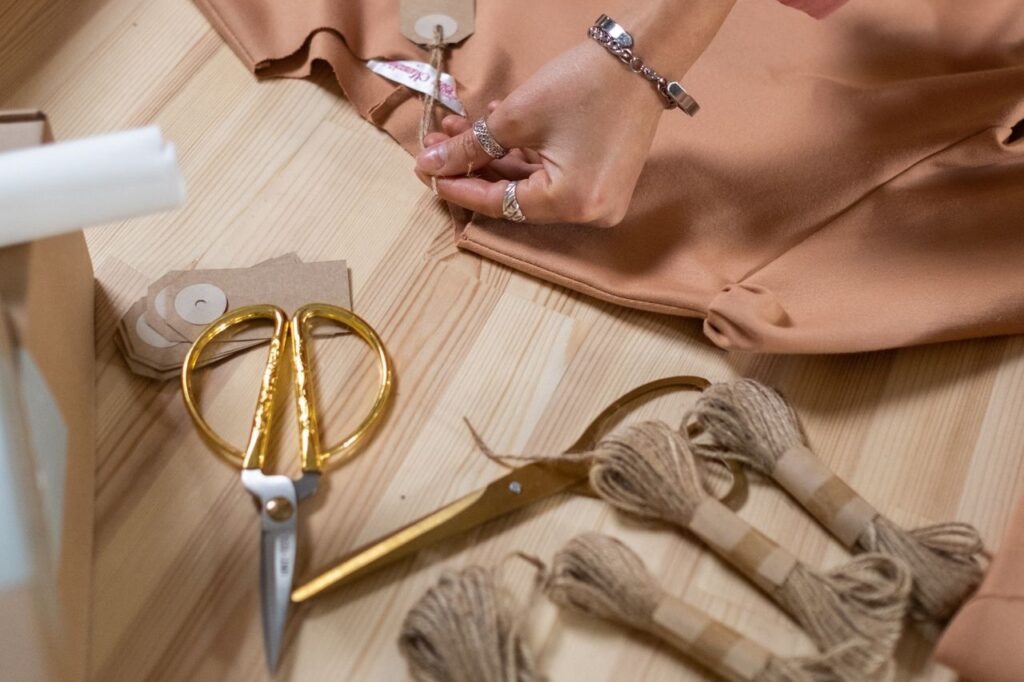
Woven labels, care labels, tags, and fabric labels are no longer just carriers of product information in today’s apparel supply chain. They directly affect wearing comfort and consumers’ perception of brand quality. Especially in premium apparel, performance sportswear, lingerie, and baby clothing markets, improper material selection can easily cause skin irritation, friction discomfort, curling after washing, or deformation. These issues may lead to customer complaints and reduced brand trust. For material procurement and quality management professionals with over 10 years of experience, woven labels are no longer low-cost accessories. Instead, they are critical components that require strict control under ISO 9001 quality management systems and ISO 14000 environmental management systems. This article provides an in-depth analysis of woven label material selection through material engineering principles and international testing standards.
Keywords: woven labels, skin-friendly woven labels, polyester satin, taffeta woven labels, label materials, wrinkle resistance
Woven Labels: Material Engineering Analysis and Skin Comfort
The skin comfort of woven labels mainly depends on yarn fineness (Denier), surface roughness, and fabric structure. When labels remain in contact with areas such as collars, waistbands, or underwear contact zones for extended periods, poor edge cutting quality or rough surface structures can create discomfort and irritation.
From a material engineering perspective, Satin weave, Plain weave, and high-density Damask weave structures differ significantly. Satin structures reduce the number of warp and weft interlacing points, creating smoother floating yarn surfaces that significantly lower the friction coefficient. In contrast, taffeta woven labels feature a tighter structure that offers excellent durability but a relatively stiffer hand feel.
Procurement managers should ensure that label materials comply with skin-contact comfort requirements and conduct strict inspections of heat-cut edge technology to prevent sharp or hardened edges caused by thermal sealing.
Comparison Table of International Testing Standards for Woven Labels
To quantify comfort and durability, adopting international testing standards is essential for quality assurance. Below are the core testing standards procurement teams should require:
| Test Standard | Test Item | Application & Purpose | Recommended Value |
|---|---|---|---|
| ISO 11092 | Thermal Resistance (Rct) & Water Vapor Resistance (Ret) | Evaluates breathability and heat dissipation for skin-contact comfort | Rct ≤ 0.02 m²·K/W |
| AATCC 128 | Wrinkle Recovery (Appearance Method) | Evaluates label smoothness after washing | ≥ Grade 4.0 |
| ISO 9237 | Air Permeability Test | Measures airflow and reduces heat buildup | 150–400 mm/s |
| ISO 12947-2 | Martindale Abrasion Test | Evaluates abrasion resistance after long-term wear | ≥ 10,000 cycles without damage |
The thermal resistance (Rct) unit for textile materials is expressed in m²·K/W (square meter · Kelvin per Watt). This value represents the ratio between the temperature difference across the specimen and the heat flux passing vertically through a unit area. Higher values indicate better thermal insulation and lower heat loss, while lower values represent improved heat dissipation performance.
Note: The recommended testing standards and values listed above are for general industry reference only. Actual specifications should be confirmed according to product design, application, and brand technical requirements.
Product Comparison Table: Performance Differences Among Common Woven Label Materials
To help procurement managers balance cost and quality, the following table summarizes the performance differences among three mainstream woven label materials:
| Performance Indicator | Polyester Satin Label (Satin) | Taffeta Woven Label (Taffeta) | High-Density Woven Label (Damask) |
|---|---|---|---|
| Skin-Friendly Comfort | Excellent (Smooth) | Moderate (Rougher) | Excellent (Flat Surface) |
| Natural Wrinkle Resistance | Very High | Low to Medium | High |
| Abrasion Resistance | 10,000+ cycles | 5,000–8,000 cycles | 8,000–12,000 cycles |
| Pattern Resolution | Low to Medium | Low | Extremely High |
| Recommended Applications | Lingerie, Babywear, Sportswear | Uniforms, Industrial Apparel | Luxury & Premium Functional Apparel |
Note: The testing data and performance ratings mentioned in this article are based on common industry practices. Actual performance may vary depending on yarn count and weaving machine tension.
Technical Analysis: How Weaving Structures of Woven Label Influence Purchasing Decisions
Skin-Friendly Strategy of Polyester Satin Woven Labels
Polyester satin woven labels utilize long floating yarn technology, reducing the exposure of fiber ends to the skin. In practical applications, this structure effectively minimizes the common “itchy label” problem in close-fitting garments.
For sensitive skin products, procurement teams are advised to request ISO 11092 test reports from suppliers to verify excellent thermal resistance and moisture vapor resistance performance, ensuring comfort during prolonged skin contact without excessive heat buildup.
Balancing Durability and Cost with Taffeta Woven Labels
Taffeta woven labels feature a stable structure that is suitable for outerwear applications. Although their skin comfort performance is relatively lower, improvements can be achieved through high-density yarns or ultrasonic edge-cutting technology.
Procurement departments should pay special attention to abrasion resistance and ensure compliance with ISO 12947-2 testing to prevent fraying, yarn breakage, or edge fuzzing after repeated washing and daily friction.
Premium Balance of High-Density Damask Woven Labels
High-density damask woven labels are widely preferred in premium and luxury products because they achieve an ideal balance between detailed graphics and surface smoothness.
Their dense weaving structure enhances logo clarity while finer yarns contribute to excellent wrinkle resistance. This makes them highly suitable for premium garments that require dimensional stability and a smooth appearance after repeated washing.
Supply Chain Quality Control and Sustainability Recommendations
When selecting suppliers, procurement teams should treat ISO 9001 and ISO 14000 certifications as essential qualification requirements in addition to material analysis.
The woven label production process involves thermal edge cutting, dyeing, and finishing procedures. Any instability in these processes may directly result in product returns. For example, excessively high heat-cutting temperatures can harden label edges, creating skin irritation even when soft materials are used.
Additionally, priority should be given to polyester yarns certified by OEKO-TEX or GRS recycled material standards. This not only helps ensure compliance with environmental regulations but also reduces compliance risks within international supply chains.
Finally, sealed sample testing should always be conducted before mass procurement. Procurement teams should evaluate not only the hand feel of materials but also verify real-world product performance through the international testing standards discussed above.
Treating woven labels as an integral part of product quality rather than merely a garment accessory is a key strategy for enhancing brand value.
Illume Ltd. provides professional product testing and supply chain management services to help products comply with global quality inspection standards (fees apply).
References
- ISO 11092: Textiles — Physiological Effects — Measurement of Thermal and Water-Vapor Resistance under Steady-State Conditions (Sweating Guarded-Hotplate Test).
- AATCC 128: Wrinkle Recovery of Fabrics — Appearance Method.
⚠️ Note: The testing methods and data mentioned in this article are based on common industry practices for reference purposes only. Actual specifications should still be confirmed according to product design, application, and brand technical standards.