
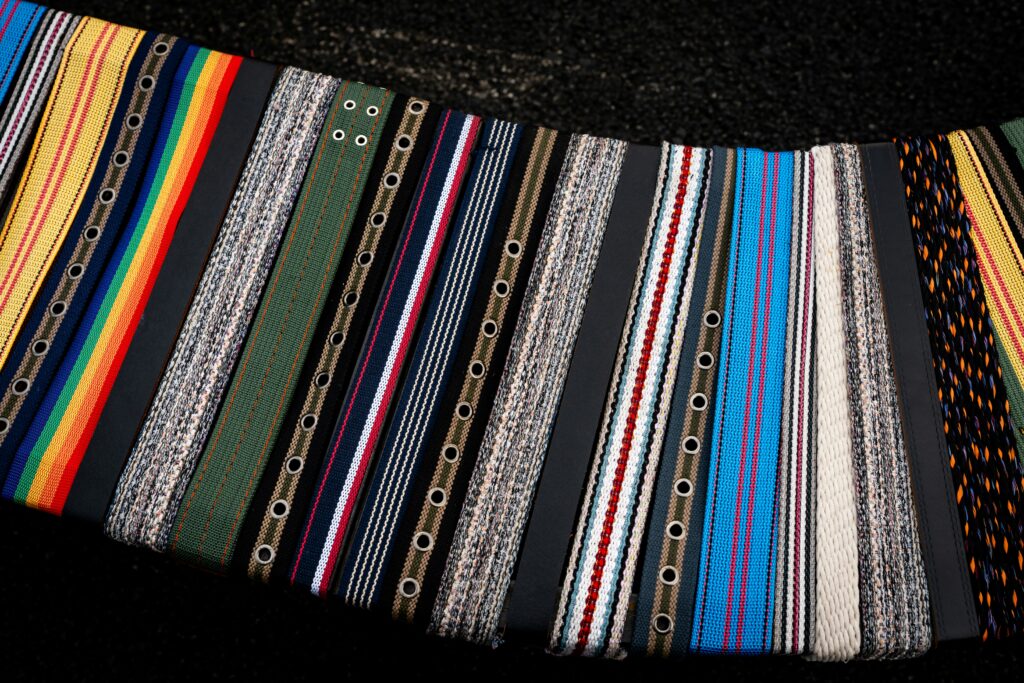
How can jacquard knitted elastic bands keep logos and text from deforming? This article explores computerized weaving technology and key testing standards such as ASTM D4964 and ISO 6330 to help designers achieve precise brand logo presentation on elastic bands while balancing aesthetics and functionality.
In the premium apparel, sportswear, underwear, and street fashion markets, knitted elastic bands are no longer just functional trim materials. They have become an important extension of brand visual identity. Many brands use jacquard logos, brand lettering, graphic symbols, and custom color combinations to increase product recognition and strengthen brand memory. However, when logos and text are woven into stretchable knitted elastic bands, issues such as text distortion, blurred edges, deformation after stretching, and logo shifting after washing can occur. As a result, maintaining stable logo presentation within an elastic structure has become a major technical challenge in custom jacquard elastic band production.
Keywords: Knitted Elastic Band, Jacquard Weaving, Brand Logo, Custom Elastic Band, ASTM D4964, ISO 6330, Computerized Jacquard Knitting, Elastic Webbing
Deformation Issues in Jacquard Knitted Elastic Bands
Knitted elastic bands naturally have high stretch and recovery properties. When logos are directly woven into the elastic band through jacquard weaving, the image may change proportion during stretching. If knitting density, yarn tension, or fabric structure is uneven, it can easily cause stretched or compressed brand text, blurred line edges, reduced readability of small fonts, failure of the logo to recover after stretching, and logo displacement after washing.
This issue is especially critical in sportswear and close-fitting garments, where elastic bands must withstand repeated stretching over long periods. Without a stable jacquard structure, fatigue deformation may occur over time.
High-quality jacquard knitted elastic bands are usually optimized through:
- High-gauge computerized jacquard machine control
- Precise yarn tension adjustment
- High-rebound elastic fiber arrangement
- Reinforced jacquard structure design
- Heat setting and stabilization finishing
Among these factors, fabric structure design is often the key element that determines whether the logo remains sharp and clear.
Key Computerized Weaving Technologies for Knitted Elastic Bands
Modern custom knitted elastic bands are mostly produced using computerized jacquard weaving systems. Compared to traditional mechanical jacquard methods, computerized control allows more accurate adjustment of:
- Stitch positioning
- Color yarn switching
- Loop density
- Pattern proportion
- Edge resolution
Brand logos often contain English letters, fine lines, or geometric shapes. If the resolution is insufficient, visual distortion may occur.
Common jacquard weaving challenges include:
- Insufficient stitch density causing blurred logos
- Low resolution creating jagged patterns
- Uneven elastic arrangement leading to deformation after stretching
- Poor heat setting causing logo shifting after washing
- Unstable yarn dyeing causing color variation
Many international brands conduct digital simulations and sample band testing during product development to confirm logo readability under actual stretching conditions.
ASTM D4964 and Elastic Stability Performance
In the development of custom knitted elastic bands, ASTM D4964 is an important testing standard for elastic performance. It is mainly used to evaluate:
- Elongation performance
- Recovery rate
- Cyclic fatigue resistance
- Elastic stability
If the jacquard area cannot recover to its original dimensions after repeated stretching, problems such as logo deformation, spacing changes, and visual imbalance may occur.
The recommended standards and testing data mentioned in this article are for industry reference only. Actual specifications should be adjusted according to product requirements.
Suggested Reference Data
- Elongation: 80%–150%
- Recovery rate: ≥90%
- Cyclic stretching: 500–3000 cycles
- Dimensional change: ≤ ±5%
For example:
- Sportswear focuses on high fatigue resistance
- Underwear products emphasize soft recovery
- Fashion garments prioritize stable logo appearance
Therefore, different markets may require different testing conditions.
ISO 6330 and the Risk of Logo Distortion After Washing
Besides stretching deformation, washing is another major factor affecting brand logo appearance. ISO 6330 is a common domestic washing testing standard that simulates real consumer laundering conditions.
The standard evaluates:
- Washing shrinkage
- Dimensional stability
- Appearance changes
- Twisting deformation
- Color stability
For jacquard knitted elastic bands, uneven shrinkage after washing may cause:
- Wavy deformation
- Text displacement
- Pattern wrinkling
- Blurred edges
Common improvement methods include:
- Heat setting for dimensional stability
- Low-shrinkage yarns to reduce washing deformation
- High-density knitting for structural stability
- Zoned tension control to prevent localized distortion
- Pre-shrinking treatment to reduce future shrinkage
Some premium brands even require repeated washing cycle tests, high-temperature laundering simulations, and post-drying dimensional verification to ensure consistent logo appearance after long-term use.
Comparison of International Testing Standards for Knitted Elastic Bands
The following table compares international testing standards related to knitted elastic bands, with a focus on jacquard quality verification. The recommended standards and testing data mentioned in this article are for reference only and should be adjusted according to product specifications.
| Testing Standard | Testing Purpose | Common Applications |
|---|---|---|
| ASTM D4964 | Elasticity and recovery performance | Jacquard elastic bands, sportswear |
| ISO 6330 | Domestic washing test | Apparel, underwear, functional garments |
| ASTM D5034 | Tensile strength testing | High-tension elastic webbing |
| AATCC 135 | Dimensional change after washing | Garments and elastic bands |
| ISO 105 Series | Color fastness testing | Brand logo color verification |
These standards are often used together. For example:
- ASTM D4964 verifies long-term stretch stability
- ISO 6330 evaluates appearance after washing
- ISO 105 checks logo color stability
When logos involve high-contrast or special colors, color fastness testing becomes even more important. These standards help designers select qualified suppliers and improve product competitiveness.
Product Application Comparison for Custom Knitted Elastic Bands
The following table compares different application requirements for custom knitted elastic bands. The recommended standards and testing data mentioned in this article are for reference only and should be adjusted according to product specifications.
| Application Type | Main Requirement | Recommended Technology | Common Risk |
|---|---|---|---|
| Sportswear | High rebound and stretch resistance | High-density jacquard | Long-term fatigue deformation |
| Underwear Products | Soft and skin-friendly comfort | Fine-gauge jacquard | Blurred lettering |
| Street Fashion Apparel | Strong logo visual presentation | Multi-color jacquard | Color variation issues |
| Children’s Wear | Washing stability | Pre-shrinking treatment | Shrinkage after washing |
| Medical Supports | High dimensional stability | Reinforced fabric structure | Insufficient recovery rate |
Different product positioning directly affects jacquard design strategies.
For example:
- Street fashion brands prefer colorful and highly recognizable logos
- Sports brands focus on fatigue resistance
- Underwear brands emphasize comfort and softness
Therefore, visual appearance, usage environment, washing conditions, stretching frequency, and long-term durability should all be considered during the development stage. Otherwise, even if the initial sample looks acceptable, mass production may still result in unstable quality.
Supply Chain Management for Knitted Elastic Bands
In addition to weaving technology, supply chain management is another important factor affecting product consistency. Mature supply chains usually establish:
- Raw material batch management
- Color variation control
- Tension calibration systems
- Production SOP management
- IPQC process inspection
- Pre-shipment dimensional verification
International brands often require:
- ISO 9001 Quality Management System
- ISO 14001 Environmental Management System
- Traceable production records
- Batch consistency verification
These systems effectively reduce:
- Bulk color variation
- Dimensional deviation
- Logo distortion
- Instability after washing
For premium brands, stable brand visual consistency is often more important than simply reducing production costs.
Illume Ltd. provides professional product testing and supply chain management services to help products comply with global quality inspection standards (fees apply).
References
- ASTM D4964: Standard Test Method for Elastic Fabric Stretch and Recovery
- ISO 6330: Domestic Washing and Drying Procedures for Textile Testing
⚠️ Note: The testing methods and data mentioned in this article are common industry references only. Actual specifications should still be confirmed according to product design, application, and brand technical standards.