
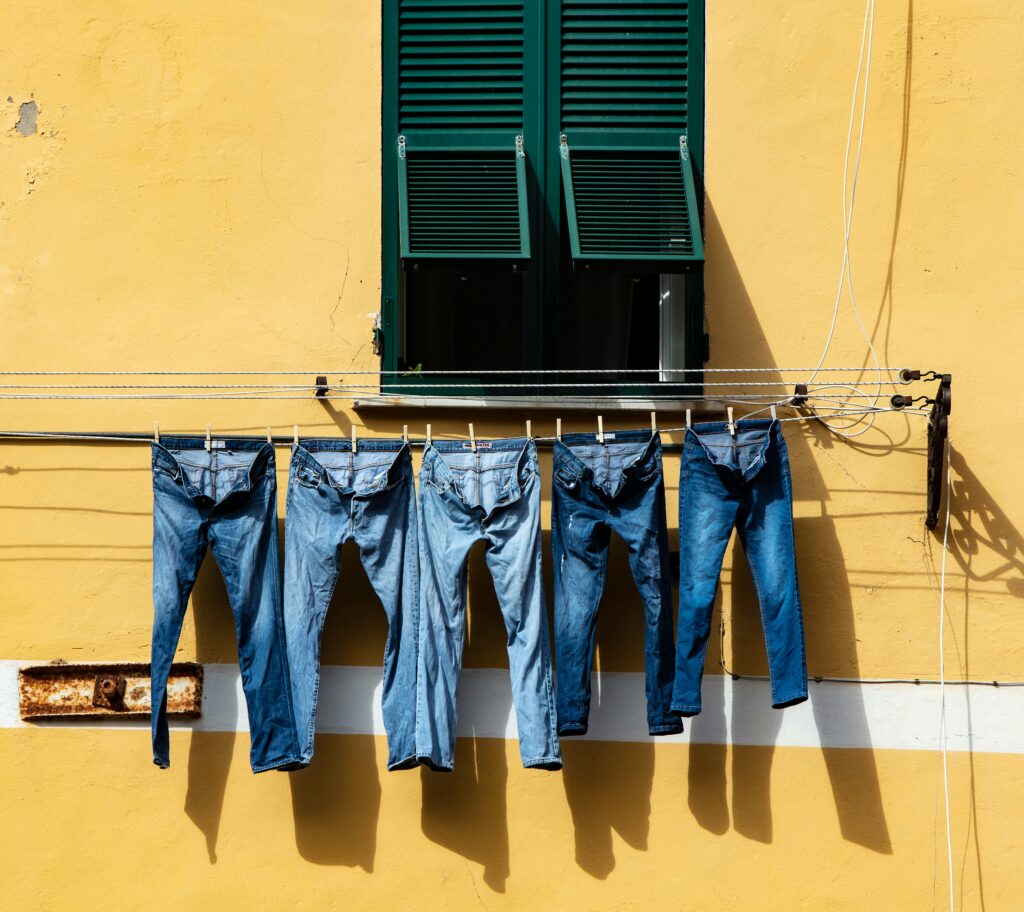
Analyzing how woven elastic bands maintain stable physical performance and appearance after high-temperature pre-shrinking, even after prolonged enzyme washing and stone washing.
In the denim apparel supply chain, washing processes such as enzyme wash and stone wash present severe challenges to dimensional stability and structural integrity. Traditional knitted elastic bands, due to their relatively loose loop structure, are prone to uncontrolled shrinkage after high-temperature drying and mechanical abrasion, resulting in waistband loosening or wave-like deformation. In contrast, woven elastic bands designed for high-tension applications, with their dense interlaced structure and advanced anti-shrink technology, have become the preferred solution for maintaining garment quality stability. This article analyzes the technical principles, testing standards, and product differences to help the supply chain address these specific technical pain points.
Keywords: Preventing post–stone wash loosening failures, woven elastic bands for denim apparel, anti-shrink technology, AATCC 135, ISO 6330, ASTM D4964
The Role of Woven Elastic Bands and Physical Challenges in Stone Washing
Woven elastic bands encapsulate internal rubber or spandex yarns through tightly interlaced warp and weft structures. They offer high density and low elongation, providing essential structural support for denim waistbands, heavyweight jackets, and functional workwear. However, stone washing is an extreme environment combining both physical and chemical stress.
During a 60 to 120-minute washing cycle, pumice stones in a 40–60°C drum continuously collide with garment trims. This mechanical damage leads to “permanent set” in the elastic core. When elastic fibers are stretched to their limits under high temperatures, molecular chains rearrange, causing a sharp decline in recovery performance. If woven elastic bands are not pre-shrunk during production, final shrinkage can easily exceed 8%, leading to waistband expansion and visible waving effects, severely affecting wearability.
Core Anti-Shrink Technology: High-Temperature Pre-Shrinking and Stress Release
To withstand washing processes, high-quality woven elastic bands must adopt high-temperature pre-shrinking technology. This process uses controlled tension and dry heat or saturated steam at 120–180°C to trigger thermal shrinkage in advance.
This technique, derived from fabric sanforization, reduces potential shrinkage from around 10% to below 3%. Its core mechanism stabilizes structural gaps, allowing the warp-weft interlacing to lock the elastic core like a framework. After treatment, the product can endure prolonged mechanical abrasion and maintain tensile strength even under enzyme-induced fiber surface degradation. For supply chains operating under ISO 9001 quality systems, this is a critical control point for minimizing incoming material risk.
International Testing Standards Comparison: Building a Data-Driven Quality System
Quality control for denim trims must rely on standardized scientific validation. The following table compares four key testing standards essential to the denim industry.
Table 1: Comparison of Relevant International Testing Standards
| Standard | Test Item | Purpose & Principle | Suggested Criteria (Reference) |
|---|---|---|---|
| AATCC 135 | Dimensional Change | Measures shrinkage after washing and drying | Warp ≤ 3%, Weft ≤ 5% |
| ISO 6330 | Washing & Drying Procedures | Simulates domestic and industrial laundering | Total shrinkage ≤ 4% |
| ASTM D4964 | Tension & Recovery | Evaluates fatigue recovery under cyclic loading | ≥85% recovery after 3000 cycles |
| ASTM D3107 | Stretch Recovery | Measures ability to return to original length | Residual recovery ≥85% |
Detailed Explanation of Table Content:
- Cross-application of AATCC 135 and ISO 6330:
AATCC 135 verifies geometric stability after denim washing through precise marking and measurement, making it essential for U.S. brands. ISO 6330 provides diverse procedures (e.g., 4A), enabling broader simulation of repeated home laundering after stone washing. - Fatigue testing value of ASTM D4964:
This standard focuses on durability and elastic retention. Over 3,000 cycles, even minor fiber breakage impacts performance. Qualified products must show minimal fuzzing and no exposure of internal elastic yarns, directly affecting whether jeans lose shape after prolonged use. - User experience relevance of ASTM D3107:
This test quantifies “elastic memory.” In heavyweight denim garments, elastic bands must withstand intense body movement. Recovery below 85% leads to noticeable loss of support.
Product Performance Comparison: Advantages of Woven Elastic in Heavy Washing
The following table compares three common elastic structures under simulated 40–60 minute enzyme stone washing conditions.
Table 2: Comparison of Elastic Band Structures
| Metric | Knitted Elastic | Standard Woven Elastic | High-Temp Pre-Shrunk Premium Woven Elastic |
|---|---|---|---|
| Structure Density | Low (loop structure collapses easily) | Medium | High (dense and stabilized) |
| Stone Wash Resistance | Weak | Moderate | Strong |
| Shrinkage (Warp/Weft) | 8–12% / 7–10% | 4–6% / 3–5% | 1.5–3% / 1–2.5% |
| Recovery Rate | 65–78% | 75–85% | ≥92% |
| Post-wash Appearance | Waving and edge curling | Slight distortion | Flat and stable |
| Recommended Use | Fast fashion, casual wear | Basic denim | Premium denim, workwear |
Detailed Explanation of Table Content:
- Structure determines durability:
Knitted elastic bands are highly vulnerable during stone washing. Once loops break, structural support is lost. Standard woven elastic is stronger, but without pre-shrinking, internal stress is released during the first wash, causing severe shrinkage. - Microscopic differences in pre-shrunk products:
Premium pre-shrunk woven elastics show highly ordered yarn alignment under microscopic observation. This structural order prevents excessive penetration of chemicals such as bleach and enzymes into the elastic core, extending product lifespan and supporting ISO 14001 sustainability goals.
Implementation Recommendations and Supply Chain Optimization
To ensure superior performance after stone washing, brands and sourcing teams should adopt the following strategies:
- Sampling stage: Require suppliers to provide third-party test reports based on ISO 6330 and ASTM D4964.
- Process optimization: Implement pre-shrinking equipment with precise tension control and adjust enzyme concentration according to denim weight.
- Dynamic monitoring: Under ISO 9001 systems, conduct AATCC 135 sampling tests for each production batch to simulate extreme washing conditions and enable data-driven decisions.
By selecting high-quality woven elastic bands and implementing rigorous anti-shrink technologies, companies can significantly reduce return rates and enhance brand credibility across global supply chains.
Illume Ltd. provides professional product testing and supply chain management services to help your products meet global quality standards (paid service).
References:
- AATCC 135: Dimensional Changes of Fabrics after Home Laundering
- ISO 6330: Textiles — Domestic washing and drying procedures
- ASTM D4964: Standard Test Method for Tension and Elongation of Elastic Fabrics
⚠️ Note: The testing methods and data mentioned in this article are based on common industry practices for reference only. Actual specifications should be determined according to product design, application, and brand technical standards.