
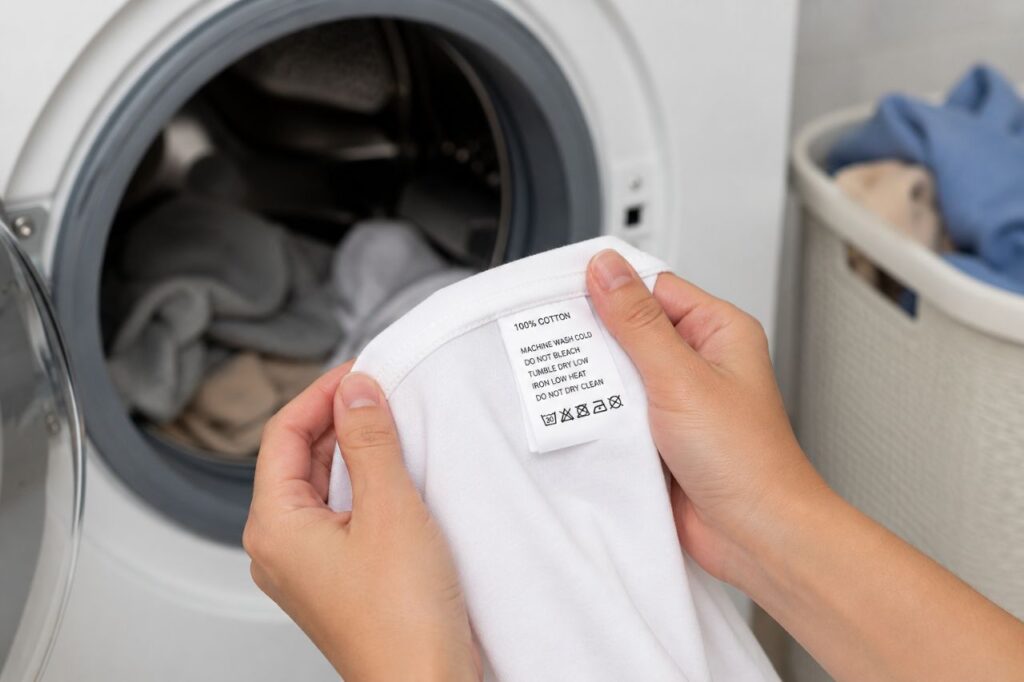
Care label durability is paramount, as the care label serves not merely as a carrier of product information, but as a critical component of brand compliance and quality management within the global supply chains of apparel, sportswear, outdoor products, and home textiles. Information displayed on the label—including washing instructions, fiber content, country of origin, and regulatory markings—must remain clear and legible throughout the entire lifecycle of the product.
Should a wash care label become blurred, lose its print, transfer color, or deform after repeated washing, it may lead to incorrect use by the consumer, resulting in product returns, customer complaints, and damage to brand reputation. Consequently, international brands frequently mandate that suppliers validate all labels in accordance with the ISO 105 Color Fastness Testing Standards and the ISO 6330 Domestic Washing Procedures to ensure sustained durability under real-life use conditions.
Keywords: Wash Care Label, ISO 105, Color Fastness, Wash Durability Testing, ISO 6330, Print Clarity
Care Label Durability Testing: Preventing Brand Complaint Risks
When evaluating suppliers, purchasing teams often focus on unit price and delivery lead time. However, many label failures do not appear during shipment inspection but only become visible after consumers wash the product several times.
A complete wash durability testing program can effectively prevent the following common failures:
- Information Readability Failure: Barcodes cannot be scanned, text fades away, or symbols become unclear.
- Color Transfer and Staining: Label dyes or inks migrate to the main fabric, causing visible damage to the garment.
- Material Failure: Label shrinkage, deformation, cracking, or peeling of heat-transfer coatings.
International Wash Durability Standards and Evaluation Logic
To convert “quality” into measurable acceptance criteria, companies should clearly define testing standards. The table below summarizes the key standards and their importance in purchasing inspections.
Table 1. Comparison of Common International Testing Standards for Wash Care Labels
| Test Standard | Testing Focus | Purchasing Acceptance Purpose |
|---|---|---|
| ISO 105-C06 | Color Fastness to Washing | Verifies color change and staining risks after washing. |
| ISO 105-A03 | Grey Scale for Staining Assessment | Evaluates whether the label may stain adjacent fabrics. |
| ISO 105-X12 | Color Fastness to Rubbing | Verifies print stability during daily wear and rubbing. |
| ISO 6330 | Domestic Washing Test | Simulates actual washing machine conditions such as temperature and agitation, serving as the foundation for durability testing. |
Recommendation: A common acceptance level for these standards is Grade 4 or above. Actual requirements should be adjusted according to product design and brand specifications.
Three Key Testing Indicators Under ISO 105 Standards
To ensure wash care label durability, laboratories typically evaluate the following three critical indicators:
- Color Change After Washing
ISO 105-C06 is used to evaluate how much the label color changes after laundering. A grey scale rating from Grade 1 to Grade 5 is commonly used, with higher values indicating better color retention.
Significant color change often indicates unstable ink adhesion or dyeing processes, creating a high risk during mass production.
- Staining of Adjacent Materials
ISO 105-A03 evaluates whether dyes or pigments from the label migrate and stain adjacent multifiber fabrics.
For high-quality garments, this is a critical performance indicator. Color transfer from labels to light-colored fabrics is a common cause of product returns and customer complaints.
- Print Clarity and Rubbing Resistance
For printed and heat-transfer labels, ISO 105-X12 rubbing tests should also be performed.
Besides preventing ink spreading, labels must ensure that barcodes, QR codes, and text remain readable after both dry and wet rubbing tests, allowing successful OCR recognition and barcode scanning.
Comparison of Common Wash Care Label Materials
Purchasing teams should select suitable label materials based on product applications and establish corresponding testing requirements.
Table 2. Performance and Risk Analysis of Common Wash Care Label Materials
| Label Type | Wash Resistance | Advantages | Potential Risks | Recommended Tests |
|---|---|---|---|---|
| Woven Label | High | Excellent durability and stable texture | Uneven yarn dyeing may cause color variation | ISO 105-C06, A03 |
| Printed Label | Medium | Flexible cost and high information capacity | Poor ink adhesion may cause fading | ISO 105-C06, X12 |
| Heat Transfer Label | High | Fine print quality and comfortable wear | Depends on adhesive layer and may be affected by temperature | ISO 105-C06, X12 |
| Laminated Label | Medium | Premium appearance and surface protection | Coating cracks may lead to information loss | ISO 105-C06, X12 |
Supply Chain Quality Inspection SOP for Purchasing Teams
Purchasing managers are advised to establish the following three-level inspection process:
- Material Verification
Review supplier specifications for base materials, inks, and color-fixing technologies.
- Testing Verification
Require suppliers to provide third-party laboratory reports, with ISO 105-C06 as the primary standard, supported by ISO 105-A03 and ISO 105-X12.
- Batch Monitoring
Conduct random verification tests before mass production to ensure consistency of inks and production processes across different batches.
It is also recommended to include the requirement of “remaining clearly readable after washing” in supplier specifications.
Conclusion
Establishing measurable quality acceptance criteria through ISO standards is one of the most effective ways to reduce supply chain risks and improve brand professionalism.
The value of wash care label quality management lies in preventing problems before they occur. By identifying potential quality risks during the development and sampling stages, companies can significantly reduce future complaints, returns, and reputation damage.
Illume Ltd. provides professional product testing and supply chain management services to help products meet global quality inspection standards (fees apply).
References
- ISO 105-C06: Textiles — Tests for Colour Fastness to Domestic and Commercial Laundering.
- ISO 105-A03: Textiles — Grey Scale for Assessing Staining.
⚠️ Note: The testing methods and data mentioned in this article are common industry references. Actual requirements should be confirmed according to product design, application, and brand-specific technical standards.