

Care label, tags, and woven labels are not only product accessories, but also important information carriers that affect product compliance, quality stability, and after-sales risk management. When garments, functional fabrics, or home textiles enter different markets, incorrect, incomplete, or inaccurate care label information may lead to product returns, customer disputes, and even damage to brand trust.
ISO 3758 is one of the most widely used international care labeling standards, defining symbol systems for washing, bleaching, drying, ironing, and professional cleaning. AATCC 61 and ISO 6330 are also commonly used as important testing standards to verify post-wash appearance, shrinkage, and colorfastness. Proper care label design and labeling management can effectively reduce supply chain risks and improve international market competitiveness.
Keywords: Care Label, ISO 3758, Laundry Symbols, Textile Labeling, AATCC 61, ISO 6330
Care Label and ISO 3758: The Foundation of Global Textile Labeling
What Is ISO 3758?
ISO 3758 is currently one of the most widely adopted textile care labeling standards in the world. It mainly regulates the symbol systems used for cleaning and maintaining garments and textile products. Its purpose is to create a unified symbol system that reduces misunderstandings between different language markets and helps consumers properly care for products according to the label instructions.
The ISO 3758:2023 version has also been updated to include new symbols, symbol adjustments, and formats that are more aligned with GINETEX standards.
GINETEX, a textile care labelling system based on symbols
GINETEX devised an internationally applicable care labelling system for textiles based on symbols. The care labelling system provides consumers and textile companies with the correct information on how to care for textile products. The process indicated by the symbols avoids any irreversible damage to the product.
What Information Is Usually Included in Care Label Design?
Care label design usually includes the following information:
- Washing instructions
- Bleaching restrictions
- Drying methods
- Ironing temperature
- Professional dry-cleaning requirements
- Fiber composition
- Country of origin
- Size information
- Manufacturer information
If the care label information does not match the actual product performance, such as labeling a garment as machine washable when it shrinks severely after washing, it may lead to after-sales disputes and customer complaints.
For purchasing and quality assurance teams, this means that the verification process should not only focus on the appearance of the finished product, but also confirm whether the testing results are sufficient to support the care label instructions.
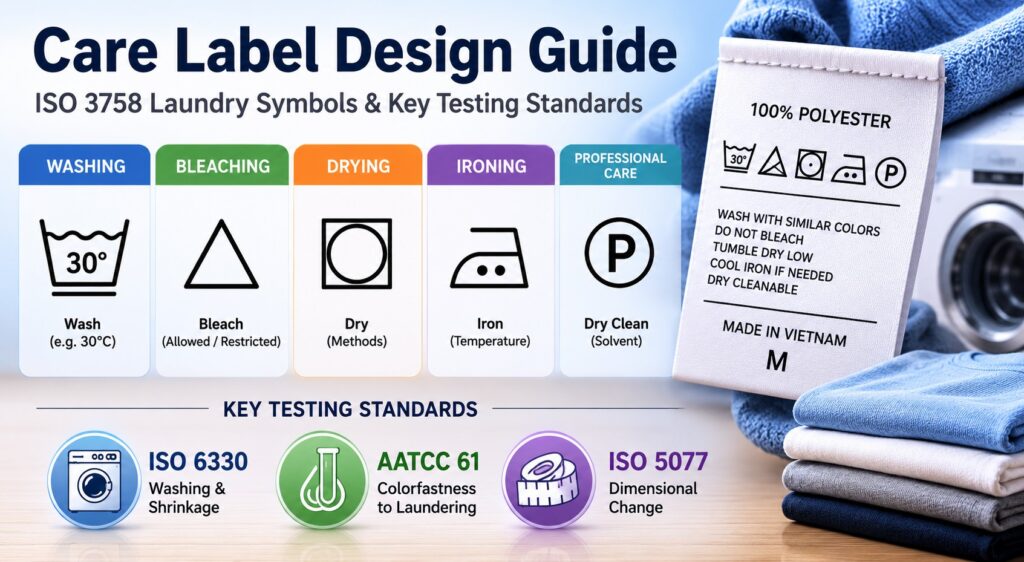
The 5 Core Laundry Symbols in ISO 3758
Washing Symbol
The wash tub symbol represents the acceptable washing methods for a product. Common symbols include 30°C gentle wash, 40°C normal wash, hand wash, and do not wash.
The number of lines underneath the wash tub indicates washing intensity:
- No line: Normal wash
- One line: Gentle wash
- Two lines: Very gentle wash
For functional apparel, elastic fabrics, and wool products, incorrect washing methods may cause fabric deformation, elastic fatigue, coating peeling, and shrinkage. Therefore, care label instructions are usually verified through ISO 6330 domestic washing tests.
Bleaching Symbol
The triangle symbol represents bleaching instructions. Common symbols include an empty triangle, a striped triangle, and a crossed triangle, representing bleach allowed, non-chlorine bleach only, and do not bleach.
Bleaching instructions are especially important for dark-colored garments, printed fabrics, coated functional materials, and elastic fiber products. If the label is unclear, consumers may use chlorine bleach, causing color fading, print cracking, or elastic fiber damage.
Drying Symbol
The square symbol represents drying methods. Common instructions include tumble dry, low-temperature drying, hang dry, flat dry, and do not tumble dry.
For knitted fabrics and elastic webbings, high-temperature drying may cause thermal shrinkage, reduced elasticity, size distortion, and fabric twisting. Therefore, many brands use ISO 6330 testing to verify dimensional stability after washing.
Ironing Symbol
The iron symbol represents ironing temperature limitations. Common levels include:
- One dot: Approximately 110°C
- Two dots: Approximately 150°C
- Three dots: Approximately 200°C
Heat-sensitive materials such as polyester, nylon, spandex, and TPU laminated fabrics may suffer surface melting, gloss changes, coating damage, or permanent pressing marks if exposed to excessive heat.
Therefore, ironing instructions on care labels must match the thermal stability of the fabric.
Professional Dry Cleaning Symbol
The circle symbol represents professional textile care methods. It is commonly used for suits, wool coats, luxury fashion garments, and silk products.
Dry-cleaning symbols usually indicate:
- Permitted solvent types
- Cleaning restrictions
- Whether professional wet cleaning is allowed
Incorrect dry-cleaning instructions may cause fabric hardening, abnormal shrinkage, color variation, or fused interlining separation. Therefore, high-end brands often require additional post-wash testing verification.
Legal Labeling Requirements
Common Labeling Requirements in Global Markets
In addition to laundry symbols, textile labeling usually requires clear information regarding fiber composition, country of origin, manufacturer or importer details, and care instructions.
Markets such as the European Union, the United States, Japan, and China each have their own textile labeling regulations. If products are exported to multiple countries, companies should confirm regulatory differences and updated requirements simultaneously.
Labels Must Match Actual Test Results
For brands and purchasing teams, care labels are not merely visual design elements. They are official product information that must be supported by testing data.
If testing results show that a product is unsuitable for high-temperature tumble drying, but the care label still indicates high-temperature drying is allowed, it becomes a clear compliance risk.
Therefore, consistency between labeling and actual testing results is critical for successful care label implementation.
Comparison Table of International Testing Standards
| Standard / Regulation | Main Purpose | Key Requirements | Application |
|---|---|---|---|
| ISO 3758 | Textile care labeling symbols | Washing, bleaching, drying, ironing, and professional cleaning symbols | Core foundation of the global care labeling system |
| ISO 6330 | Domestic washing and drying procedures | Simulates real household washing processes | Verifies shrinkage, dimensional stability, and label accuracy |
| AATCC 61 | Colorfastness to laundering test | Simulates colorfastness changes under accelerated washing conditions | Evaluates dye stability and fading performance |
| ISO 5077 | Dimensional change after washing | Measures size variation after laundering | Used to confirm shrinkage compliance |
| ISO 105-C06 | Colorfastness to washing | Tests wash durability of dyed fabrics | Suitable for products requiring stable colorfastness |
The above testing data and suggested standards are for general industry reference only. Actual requirements should still be confirmed according to product design, application, and brand technical specifications.
Comparison Table of Care Label Design for Different Products
| Product Type | Care Label Focus | Common Risks | Recommended Test |
|---|---|---|---|
| Sportswear | Low-temperature washing and avoiding high-temperature drying | Elastic fatigue and reduced functionality | ISO 6330 |
| Baby Apparel | No harsh bleaching and clear labeling | Skin irritation and chemical residue risks | AATCC 61 |
| Wool Products | Hand wash or dry clean | Felting deformation and shrinkage | ISO 5077 |
| Functional Jackets | No high-temperature drying and avoid ironing coatings | Coating peeling and appearance damage | ISO 6330 |
| Luxury Fashion | Professional dry cleaning and cleaning restrictions | Structural deformation and material damage | ISO 3758 |
Different products require different care label instructions because of material characteristics.
For example, sportswear often uses elastic fibers and moisture-wicking materials. High-temperature drying may shorten the lifespan of elasticity, so care labels usually recommend low-temperature washing and natural drying.
Baby apparel requires special attention to chemical residues and bleaching restrictions. Therefore, care labels should avoid vague or overly simplified instructions.
Luxury fashion products often contain silk, wool, fused interlining, or special coatings, so most brands specify professional dry cleaning to reduce after-sales disputes.
Common Care Label Problems Faced by Purchasing Managers
Incorrect Symbols
One of the most common issues is the use of symbols that do not comply with ISO 3758, or mixing versions from different markets.
Such mistakes directly reduce labeling credibility and may affect retailer approval processes.
Inconsistent Temperature Labels
If testing results show that high-temperature drying is unsuitable, but the label still allows tumble drying, it becomes a high-risk mismatch.
This situation often leads to returns and after-sales disputes.
Incorrect Fiber Composition
If the fiber composition label does not match the actual fabric, it may trigger customer complaints or platform reports.
Purchasing teams should request complete material certifications from suppliers.
Missing Country of Origin
If country-of-origin information is unclear or missing, it may affect market access and legal responsibility.
This is a basic but critical requirement during purchasing reviews.
Improper Symbol Arrangement
Even if the symbols themselves are correct, improper arrangement order or layout design may still cause misunderstandings.
It is recommended that suppliers provide officially approved artwork for confirmation.
Actual Test Results Do Not Match the Care Label
If testing results do not match the care label instructions, corrections should be requested immediately.
If these issues are discovered only after mass production, the associated costs can increase significantly.
Recommended Purchasing Verification Process
What Should Be Confirmed During Sampling?
During the sampling stage, companies should first confirm whether fabrics, trims, and draft care labels are consistent.
The most important task at this stage is aligning testing conditions, label versions, and market requirements.
If inconsistencies already appear during sampling, risks will only become larger during mass production.
What Should Be Confirmed Before Mass Production?
Before mass production, companies should confirm the final testing reports, care label layouts, and destination market versions.
If multiple market versions exist, a clear version control system should be established.
It is also recommended to request written confirmation from suppliers instead of relying on verbal promises.
What Should Be Confirmed During Final Inspection?
During inspection, companies should not only check product appearance, but also confirm whether the care label content matches the approved sample.
If symbols, temperatures, or text descriptions have changed, companies should immediately investigate whether formal approval procedures were completed.
This is the final safeguard before large-volume shipments are released.
Document Retention and Responsibility Management
Purchasing teams should retain testing reports, approved care label artwork, revision records, and supplier confirmation documents.
These records are extremely important when handling customer complaints, returns, or determining responsibility.
Without documentation, it becomes difficult to determine whether problems originated from design, manufacturing, or labeling.
Conclusion
Care labels are not just product accessories. They are also important components of brand quality management and supply chain risk control.
Through the ISO 3758 care symbol system, together with ISO 6330 and AATCC 61 testing verification, companies can effectively improve consumer garment care experience, international regulatory compliance, product durability, professional brand image, and supply chain quality stability.
As global textile labeling requirements continue to increase, companies that establish complete care label design and testing procedures during product development will be better positioned to reduce after-sales risks and improve market competitiveness.
FAQ
Must Care Labels Follow ISO 3758?
ISO 3758 is a widely used international laundry symbol standard that improves consistency across different markets. However, actual requirements should still be confirmed together with local regulations and product specifications.
What Is the Difference Between ISO 6330 and AATCC 61?
ISO 6330 focuses on simulating household washing procedures, while AATCC 61 focuses on accelerated laundering colorfastness testing. The two standards serve different purposes but can complement each other.
What Should Purchasing Teams Focus on During Inspection?
The priority should be confirming whether care label information matches the testing reports, including washing temperature, drying limitations, colorfastness results, and dimensional change data.
Can Care Label Content Be Directly Copied from Suppliers?
Directly using supplier versions is not recommended. Companies should first verify whether the content matches actual test results, brand specifications, and target market regulations.
How Should Multi-Market Care Labels Be Integrated?
It is recommended to use ISO 3758 symbols as the foundation, then add required text instructions and local regulatory information for each market to avoid compatibility issues across regions.
Illume Ltd. provides professional product testing and supply chain management services to help clients meet global quality inspection standards (fees apply).
References
- ISO 3758 — Textiles — Care labelling code using symbols
- ISO 6330 — Domestic washing and drying procedures for textile testing
- AATCC 61 — Colorfastness to Laundering, Home and Commercial
⚠️ Note: The testing methods and data mentioned in this article are common industry references only. Actual requirements should still be confirmed according to product design, applications, and brand technical standards.